La Dorada, Colombia · 24 August 1980
A horse born to a mule
In 1979 a Colombian team led by veterinarian Fernando Salazar Valencia transferred a horse embryo into a mule without surgery. In 1980 the mule carried it to term. This is the story of that work, and of how it was left out of the scientific record.

Estrella Blanca (White Star) with the filly Yellow Pride, 1980. Photo from Fernando's professional brochure.
01
A filly born to a mule
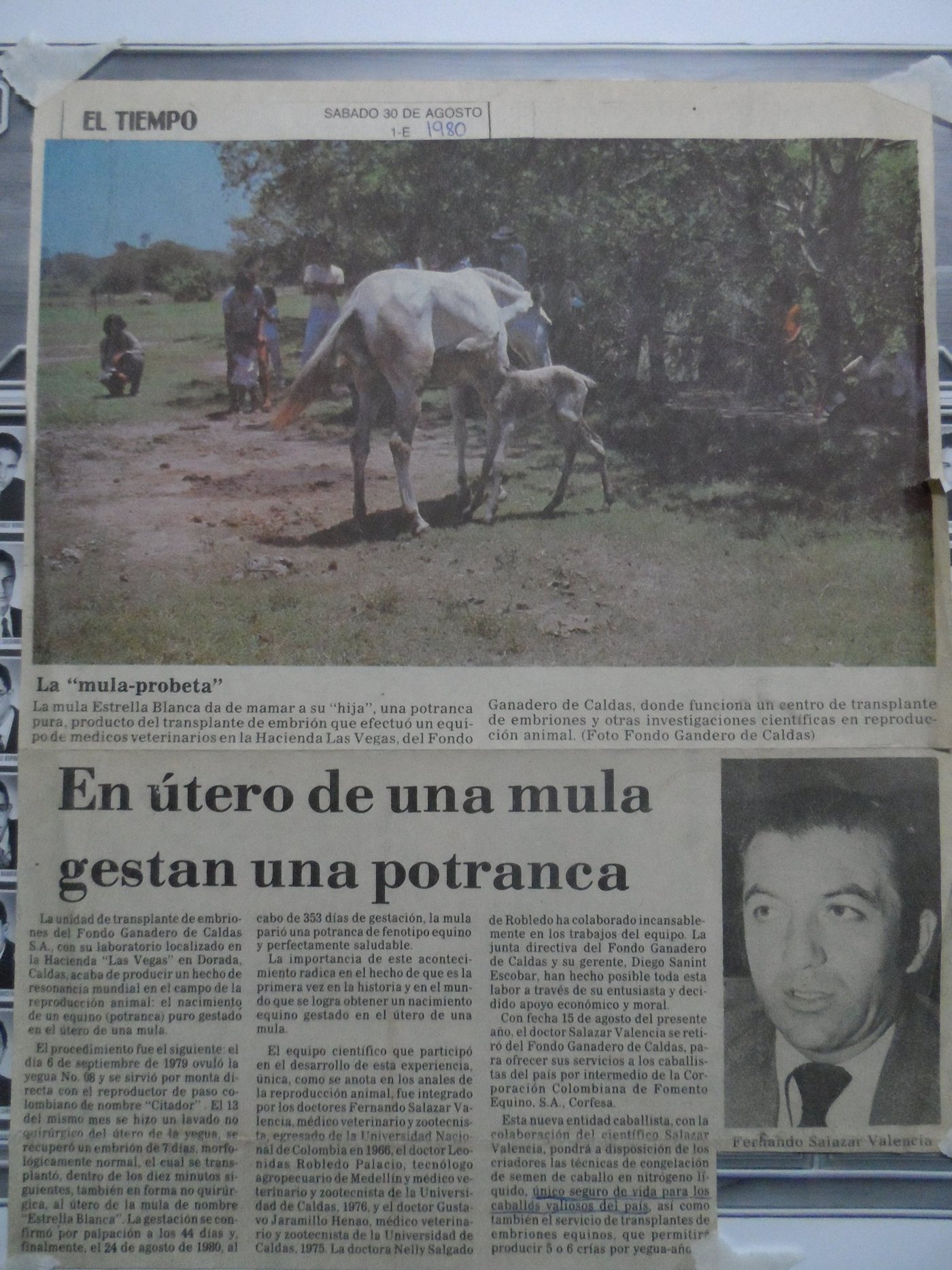
On 24 August 1980, on a cattle ranch in the hot lowlands of central Colombia, a mule named Estrella Blanca (White Star) gave birth to a healthy horse filly. Mules are almost always sterile. This one had carried a horse embryo for 353 days after a team of Colombian veterinarians placed it in her uterus without surgery. The filly was named Yellow Pride.
The work was done by the Embryo Transfer Unit of the Fondo Ganadero de Caldas, a regional cattle-development fund. Its laboratory sat on the Hacienda Las Vegas, near La Dorada, Caldas, and Dr. Fernando Salazar Valencia headed it.
How it was done
- 6 Sep 1979 A mare in the unit's herd ovulated and was bred to Citador, a Paso Fino Colombiano stallion.
- 13 Sep 1979 The team flushed the mare's uterus without surgery and recovered a normal seven-day embryo and photographed it. Within minutes they transferred it, again without surgery, into the uterus of Estrella Blanca, a nine-year-old draft-type mule.
- Day 44 The pregnancy was confirmed by rectal palpation.
- 24 Aug 1980 Estrella Blanca foaled. The 27 kg filly looked like any horse foal and was in perfect health. The mule nursed and raised her.
The team was led by Dr. Salazar Valencia with Dr. Leonidas Robledo Palacio and Dr. Gustavo Jaramillo Henao, with Dr. Nelly Salgado de Robledo assisting. The fund's manager, Diego Sanint Escobar, backed the work.
Reported at the time
Bogotá's El Tiempo reported the birth on 30 August 1980, six days later, and called it a first in the history of animal reproduction. In January 1981, Dr. Salazar Valencia showed a film of the foaling at the annual meeting of the International Embryo Transfer Society in Denver; it is listed in the journal Theriogenology (vol. 15, p. 133).
More than twenty years later, a 2003 scientific paper presented non-surgical transfer of horse embryos into mules as new. The rest of this site tells how that happened.
02
Who was Fernando Salazar Valencia?

Fernando Salazar Valencia (1939–1990) was a Colombian veterinarian who spent his career bringing reproductive technology to the cattle and horses of the tropics.
He graduated as a veterinarian and animal scientist from the Universidad Nacional de Colombia in 1966 and joined its veterinary faculty in Bogotá. Between 1969 and 1971 he did a master's in reproductive physiology in the United States, focused on embryo transfer. He worked with Professor E. S. E. Hafez, one of the leading reproduction scientists of the time, first at Washington State University in Pullman and then at Wayne State University in Detroit. He returned to teach at the Universidad Nacional until 1974, then at the Universidad de Caldas in Manizales.
In 1977 he took charge of the new Embryo Transfer Unit of the Fondo Ganadero de Caldas. Working five degrees north of the equator, where mares breed all year, his team developed non-surgical methods to recover and transfer horse embryos. He reported that work to the International Embryo Transfer Society in 1980, and the birth of Yellow Pride to the mule Estrella Blanca followed that August. He was a member of the Society and served on its nominating committee for the 1981 meeting in Denver.
The unit's main work was with cattle. In a Miami radio interview from about 1979, he explained how embryo transfer lets one valuable cow produce up to 20 calves a year, carried by ordinary cows. He said Colombia was the fifth country in the world to use the technology commercially, the first in the tropics and the first with Zebu cattle, and that a program with about 3,000 recipient cows was about to begin. He was in Miami on his way to Norval, Ontario, at the invitation of the Japanese veterinarian Dr. Hiroshi Kanagawa of Modern Ova Trends, then a leading commercial embryo transfer firm in Canada. The two had worked together in the United States some years earlier.
On 15 August 1980, days before the foaling, he left the Fondo Ganadero to found the Corporación Colombiana de Fomento Equino (Corfesa), the Colombian Equine Development Corporation. Through it he offered Colombian breeders horse embryo transfer and stallion semen frozen in liquid nitrogen. In 1983 he reported to the Society on embryo recovery in Paso Fino mares and on freezing stallion semen in the tropics. By the mid-1980s the company also operated from Miami, Florida.
He was also a member of the Italian society for zootechnics (Società Italiana per il Progresso della Zootecnica) from 1972.
Fernando Salazar Valencia died on 4 May 1990.
Career
- 1966DVM, Universidad Nacional de Colombia
- 1968–1974Assistant professor, Universidad Nacional de Colombia
- 1969–1971Master's study in reproductive physiology with E. S. E. Hafez, Washington State University and Wayne State University
- 1975–1977Professor, Universidad de Caldas
- 1977–1980Head, Embryo Transfer Unit, Fondo Ganadero de Caldas
- 1980–1990Founder, Colombian Equine Development Corporation (Corfesa)
03
Known and cited in the 1980s
For most of the 1980s the Colombian foal was part of the scientific record.
In 1983 Cornell University and the University of Cambridge began their own study of horses and donkeys carried by mules, to learn how the mother's immune system tolerates a foreign pregnancy. Their embryos were placed surgically, through an incision in the abdomen, by W. R. “Twink” Allen of Cambridge. Two Thoroughbred foals and a donkey were born to mules at Cornell in the summer of 1984.
Announcing those births, Cornell's newsletter Veterinary Viewpoints said they followed a single earlier report, from 1982, of
“a horse born to a mule mother in Colombia.”
Veterinary Viewpoints (Cornell University College of Veterinary Medicine), vol. 3, 1984, p. 4
That earlier report was Fernando Salazar Valencia's. Books and journals in several countries cited his work through the decade:
- 1984Cornell's Veterinary Viewpoints names the Colombian foal as the precedent for its own.
- 1985The Horse (Karen Redmond, ed.) repeats the Colombian precedent, p. 17.
- 1986Gwatkin, Manipulation of Mammalian Development, cites the 1981 film entry, p. 277.
- 1987Ontogenez (Soviet Journal of Developmental Biology), vol. 18, cites the 1981 film entry.
- 1987Smith, Techniques for Processing and Preserving Equine Semen, cites his 1983 abstract, p. 167.
- 1991Cupps, Reproduction in Domestic Animals, cites his 1983 abstract, p. 277.
- 1997Arquivo Brasileiro de Medicina Veterinária e Zootecnia cites his 1983 abstract, p. 211.
04
How it was left out
From 1985 on, the papers that came to define the field did not mention the Colombian work.
In 1985 the Cornell–Cambridge group published its mule pregnancies in two papers in the Equine Veterinary Journal: Allen, Kydd, Boyle and Antczak, and Davies, Antczak and Allen. Neither cites the Colombian foaling that Cornell's own newsletter had acknowledged the year before. Later reviews by Allen credit the 1985 papers alone.
Fernando Salazar Valencia died in 1990. In 1994 the magazine Semana told the story of the mule mother and credited it to Gustavo Jaramillo, a member of the team. It did not name Fernando.
In 2003 a group from the University of Pisa, with Allen as senior author, reported the non-surgical transfer of horse embryos into mules. That is the method the Colombian team had used in 1979. The paper says:
“Previously, only Davies et al. (1985) had used mules as equine embryo recipients.”
Camillo et al., Reproduction in Domestic Animals 38:380–385, 2003
Later papers cite the 2003 study as the origin of the technique.
- 1985Allen et al. and Davies et al., Equine Vet J Suppl. 3: no mention of Colombia or Salazar.
- 1994Semana, “La mula madre”: credits Jaramillo and does not name Fernando.
- 1997Allen and Short, Journal of Heredity: horse-in-mule pregnancies credited to the 1985 papers only.
- 2003Camillo et al.: non-surgical horse-in-mule transfer, with Davies 1985 named as the only earlier mule work.
- 2008A Colombian paper in Revista Politécnica (Medellín) describes the world's first horse embryo carried by a mule, but credits the Universidad de Caldas rather than Fernando or the Fondo Ganadero.
- 2010Allen, Animal Reproduction Science: mule recipients credited to Davies 1985.
- 2017Víctor Cotrino, a Bogotá veterinarian, writes that more than forty years earlier Dr. Fernando Salazar “dazzled us” with Colombia's first embryo transfer reports in cattle and horses.
- 2017A Spanish donkey-in-mule study credits Camillo 2003 for non-surgical transfer to mules.
- 2020Allen and Wilsher, “Historical aspects of equine embryo transfer”: no mention of Colombia.
- 2021W. R. Allen dies.
- Nov 2026Prof. Francesco Camillo, lead author of the 2003 paper, tells the family he had not known of the Colombian work and would otherwise have cited it.
We do not know why the Colombian work dropped out. The 1980 and 1981 reports were a short abstract and a film, which are easy to miss. But Allen performed the surgeries for the Cornell project that acknowledged it in 1984.
05
The evidence
These are the documents this account rests on. Most are in the family archive or in published journals that any library can retrieve.

06
What is still open
Some questions remain. As answers come in, this page will be updated.
- Is the 1981 film of the foaling preserved? We have asked the International Embryo Transfer Society and Colombia's national film and broadcast archives.
- What did W. R. Allen know of the Colombian foal when he co-wrote the 2003 paper? Its lead author did not know of it. We have asked Allen's colleagues at Cornell and in Sharjah.
- What was the “1982 report” Cornell referred to? It may be a review by W. R. Allen published that year.
- Who placed the embryo by hand? The press credits the team Fernando led; the family recalls that he did it himself.
- Do parentage or blood-typing records survive that confirm Estrella Blanca was a mule and Yellow Pride a horse?
- What became of Yellow Pride and Estrella Blanca after 1980?
- Do the Fondo Ganadero de Caldas records survive?
Can you help?
If you worked with the Fondo Ganadero de Caldas or with Corfesa, knew Fernando Salazar Valencia, or have photographs, films or papers from this work, please write to the family at mario.salazar.h@gmail.com.